
Troubleshooting a Dishwasher Not Heating or Drying Properly
You’ll notice two or three indications which make it simple to spot if your dishwasher isn’t heating up the water or drying your dishes appropriately – at the end of a wash cycle your dishes won’t be clean, and they won’t be dry. Absence of high temperature water can be created by a couple of various reasons and the problem is also reliant on your dishwasher model and whether it is plumbed into the hot or cold water supply.

That said, the following are some causes that you can diagnose and repair yourself.
Heating Element
Irrespective of whether it is plumbed into a cold or hot water supply, your dishwasher will have a heating component (noticeable in the tub) or a flow through heater (which isn’t exposed) that are utilized to control the water temperature and help in the drying process.
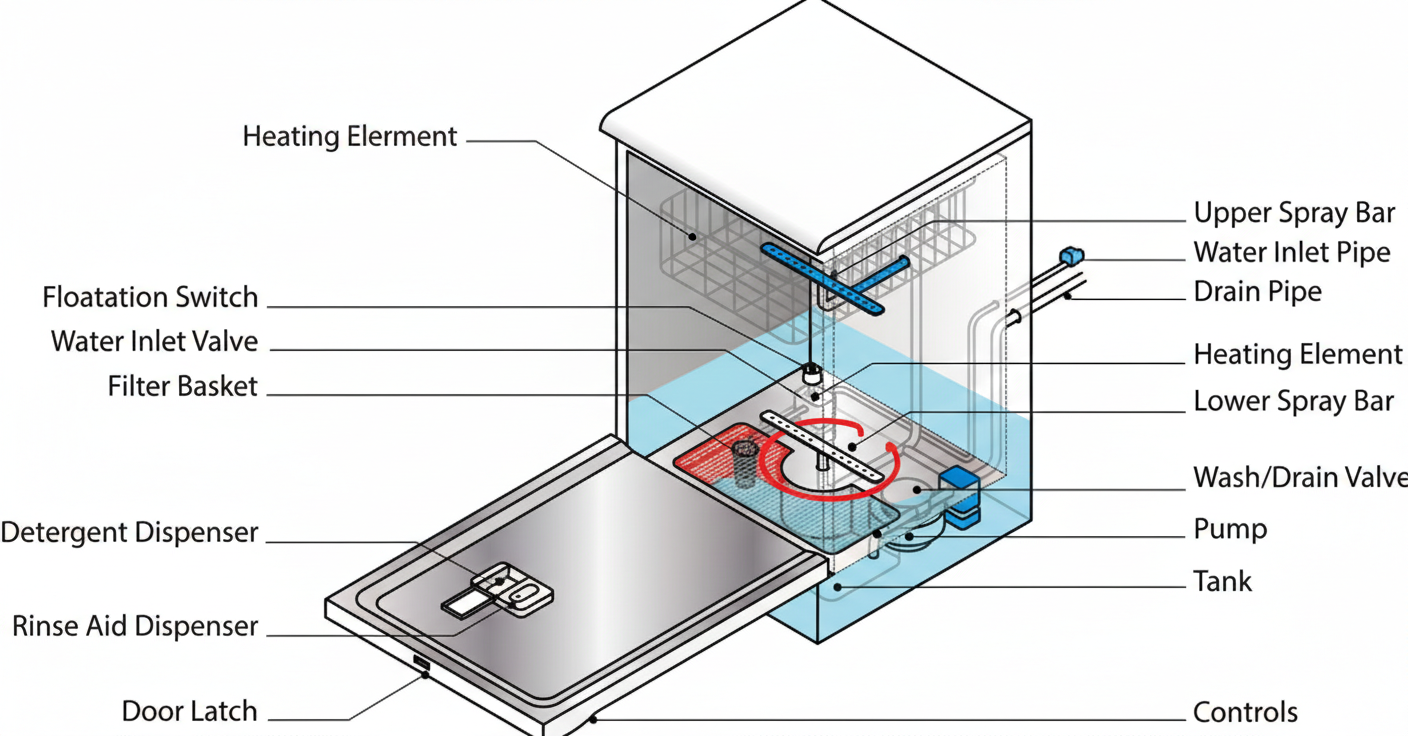
[Image of dishwasher heating element location]
| Component | Role in Heating/Drying |
|---|---|
| Heating Element | The primary source of heat for both water warming and air drying. |
| Rinse Aid Dispenser | Essential for “sheeting” water off dishes to prevent spots during drying. |
| Floatation Switch | If stuck “up,” it may prevent the dishwasher from filling, which stops the heater from activating to prevent burnout. |
| Wash/Drain Valve | Ensures water is fully removed so the drying cycle isn’t trying to evaporate a pool of standing water. |
In spite of the fact that the heating component is an extremely dependable component of a dishwasher, it can wear out or suffer an electrical/wiring fault.
If you have a multimeter you can measure the resistance of your heating component which should indicate around 15 and 30 ohms. A reading above 30 implies the component is defective and should be changed.
Thermostat
The thermostat is the other part that can regularly cause your dishwasher to not heat the water. The job of the thermostat is to maintain the water temperature all through a wash cycle. If it’s defective then the dishwasher won’t “know” when to turn the heater on or off to keep the water at the required temperature.
Much the same as the heating element, you can test the thermostat utilizing a multimeter to figure out if or not it is the source of the issue. Fortunately, it’s an exceptionally cheap part if you have to replace it, the hard part is accessing it as you’ll find it underneath the dishwasher.
Hot or Cold Plumbing?
Whilst all dishwashers can work utilizing the cold water supply and warming water internally, numerous individuals interface their dishwasher to the boiling hot water supply if their model allows it, as it can be more energy effective and modest (particularly if you run a cold/no-drying program).
If you have your dishwasher connected to the cold water supply then it’s exceptionally likely that a defective heating element or thermostat is the reason why the water is not getting warm.
In case you’re interfacing with hot water then it helps checking the water supply to ensure that there is no issue with the dishwasher and not somewhere else. Try running the hottest washing program, to check whether the dishwasher itself can warm the water to the required temperature.
Professional Assistance for Leading Brands
If you are unable to resolve the heating issue on your own, it may be time to consult a professional. Our experts are experienced with a wide range of manufacturers, including:
- LG & Samsung
- Sub-Zero & Viking
- KitchenAid & Whirlpool
- Bosch & Miele
- GE & Frigidaire
- Maytag & Kenmore
If your unit continues to struggle with water temperature, visit our service page for help addressing electronic control faults. For more general appliance repair guidance, you can explore our homepage.